
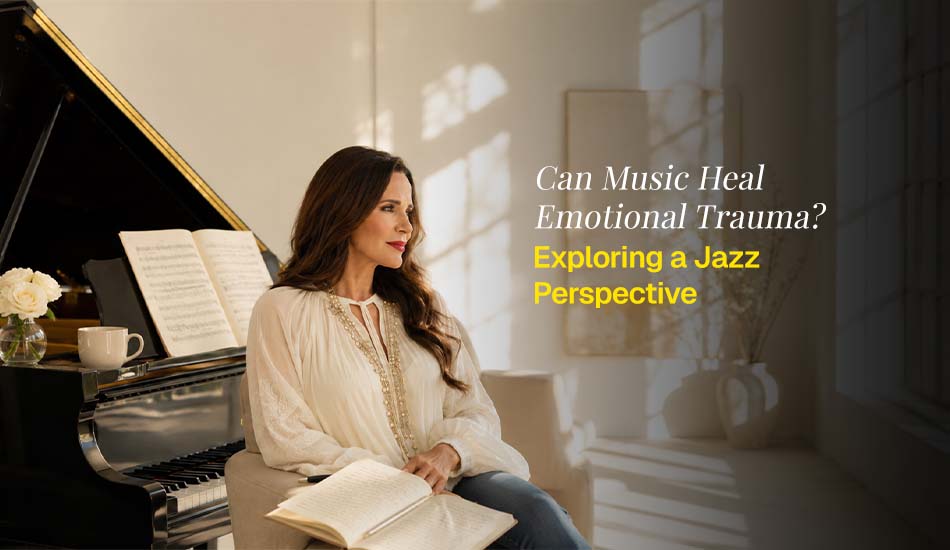
For millennia, mankind has experienced joy, loss, and celebration with music there to help us through recovery. People sought out music for solace in times of crisis long before any scientific research began to investigate its effects. Researchers, therapists, and musicians still pursue the age-old question: Can music actually heal emotional trauma?
No song can take away a traumatic experience, but music can allow us to exist in the space of our feelings without trying to diminish them. Jazz is special amongst all musical genres because of its emotional honesty, improvised nature, and representation of the human experience.
The relationship between jazz music and emotional healing goes beyond entertainment. For many listeners, jazz becomes a companion through grief, change, loneliness, and recovery. It offers something rare: permission to feel without judgment.
Understanding Emotional Trauma
Emotional trauma happens when someone goes through an emotional event or a state of being that is too suffocating to fully process. Loss, abuse, illness, accident, and trauma are the things that can fuel the fear of experiencing distress, often leading to prolonged periods.
Increases often occur after the off-cuts period, and these impacts can take several forms:
- Anxiety
- Depression
- Emotional numbness
- Difficulty trusting others
- Sleep disturbances
- Persistent feelings of sadness or fear
It is classic for recovery from trauma to not be a straight line. This takes time, love, and healthy outlets for emotion. This is where the music actually comes in.
The Science Behind Music and Emotional Healing
Science has more and more evidence to back up the notion that music affects our emotional as well as physiological states.
Many areas of the brain are activated by listening to music, including those connected with:
- Memory
- Emotion
- Attention
- Reward
- Stress regulation
Research has indicated that music can:
- Lower cortisol (stress hormone) levels
- Stimulate dopamine production
- Improve mood
- Support relaxation
- Encourage emotional expression
Due to the effects music has on both mind and body, it is widely used in settings that include therapy. Music should never replace professional treatment, but it can assist in the emotional healing process.
Why Jazz Holds a Special Place in Emotional Healing
Though many genres can move people emotionally, jazz has something more to uniquely offer.
Jazz embraces imperfection. One that is open to uncertainty, vulnerability, and spontaneous happenstance. Whereas jazz embraces complexity, feeling is relegated to simple categories.
The vulnerability we can find in both jazz music and emotional healing are two reasons this connection feels so intuitive.
Jazz often reflects real life:
- Unpredictable
- Imperfect
- Reflective
- Resilient
The emotional trajectory of a jazz performance is rarely so straightforward. In essence, it unfolds like the healing itself: moment by moment.
How Jazz Helps Process Difficult Emotions
The emotional space jazz can create is one of its greatest strengths.
Unlike a lot of music, which tends to distract listeners from uncomfortable parts of the human condition, jazz often leads them into self-examination. A melody may evoke memories. The feel of a word spoken out loud is training. You might stumble across and articulate emotions that are hard to speak about.
Jazz can help people.
- Sit with uncomfortable emotions
- Reflect on personal experiences
- Reduce feelings of isolation
- Experience emotional release
- Develop greater self-awareness
In contrast to more energetic, even aggressive music that can act as a short-term placater for emotional pain (think pounding bassline pseudo-raps), jazz tends towards the opposite approach: inviting listeners into their emotions and urging them on gently with an adequate amount of support.
Jazz Musicians Who Transformed Pain Into Art
Over the years, hundreds of jazz musicians have taken what they face in their lives as a personal battle and put it into an incredible piece of art.
Artists such as:
- Billie Holiday
- Nina Simone
- Chet Baker
- John Coltrane
Incorporated music and used its power to help her through pain, strength, and transformation.
Many female jazz vocalists are still carrying this torch today, writing music emblematic of vulnerability and healing while encasing those messages in some absolute emotional truth.
Their efforts remind listeners that such difficult experiences can turn into a source of creativity and connection.
Jazz and Music Therapy
Music therapy is a well-established clinical practice utilized in hospitals, rehabilitation centers, mental health programs, and, more recently, wellness settings.
A competent music therapist may utilize listening, writing, improvisation, or performance exercises to facilitate individuals’:
- Process trauma
- Reduce anxiety
- Improve communication
- Strengthen emotional regulation
This flexibility, harnessed in improvisation during jazz sessions, can make it easier for patients to open up and express emotions; hence, the value of jazz when used therapeutically.
The connection between jazz music and emotional healing is often strongest when music becomes an active experience rather than passive background sound.
Practical Ways to Use Jazz for Emotional Wellness
If you want to listen to jazz and get emotional benefits from it, there is no need for formal training.
Here’s how you can jazz up your wellness game:
Mindful Listening
Select a track, and listen. Listen for the instruments, dynamics, and changes in feel.
Journaling with Jazz
Listen to skillful, reflective jazz recordings and write down your thoughts and feelings.
Evening Relaxation
Soft jazz can be a soothing sound before you drift off to sleep.
Live Performances
Live jazz performances generally form a more important emotional connection than recordings alone.
Learning an Instrument
Even simple improv exercises can result in emotional release and creative expression.
Recommended Jazz Albums for Reflection and Healing
Now music is a personal preference, but here are some of the best non-crying-like albums:
- Blue in Green
- A Love Supreme
- Lady in Satin
- Pastel Blues
- Live with Christian Jacob
Some listeners also find resilience through the work of modern jazz vocalists, whose recordings often share a common narrative arc: vulnerability and healing.
The Limits of Music as a Healing Tool
Music can help with emotional wellness, but understand the limits of music.
Some cases of severe trauma, PTSD, or other mental health disorders inevitably need professionals to treat them, such as licensed therapists/psychologists and medical practitioners.
Music can play a role along with therapy, but it should not be considered as an alternative to the right kind of care.
It is definitely not that easy, as we have different persons with differing relationships and responses to music present.
The Unique Lessons Jazz Teaches About Recovery
One of the greatest lessons that jazz teaches is this: imperfection does not detract from beauty.
Jazz teaches us:
- Not every note needs to be clean.
- Mistakes can lead to discovery.
- Growth often happens through uncertainty.
- Healing is rarely linear.
These teachings are illustrative of the recovery process itself.
In the same way that a jazz musician is trained to lyrically improvise through surprise, people recovering from emotional trauma often learn how to bounce back with grace and kindness amidst uncertainty.
Conclusion
The relationship between jazz music and emotional healing is rooted in authenticity.
Jazz is not a panacea or an elixir. Instead, it leaves room for reflection, honesty, and emotional connection. It gives listeners permission to acknowledge pain without getting mired in it.
Whether it comes through the storytelling ability of female jazz vocalists, the artistry of modern jazz vocalists, or the timeless emotion found in some of the best jazz songs, we’ll continue to have a soundtrack to guide us while we navigate life.
It’s worth noting music alone cannot heal emotional trauma, but it may serve as an essential companion on the path to healing.
FAQ Section
Can Music Really Heal Emotional Trauma?
Sound can promote emotional healing by alleviating stress, facilitating expression of emotions, and providing opportunities for reflection. But it doesn’t substitute for professional care when necessary; rather, it should supplement it.
Why is jazz considered a healing emotion?
Jazz has emotional complexity, improvisation, and intimacy, providing space for listeners to emotionally process through safe reflection.
What type of jazz music is best for relaxation and contemplation?
In this sense, cool jazz, piano, and ballads as well as calm vocal jazz became popular.
Does listening to sad music help with emotional processing?
For many people, yes. A study published on Nov 19, 2020, in Jazzyphil conducted a meta-mediation analysis to find out how emotionally expressive music can help us lessen our feelings of isolation and sadness.
How does music therapy support trauma recovery?
Music therapy relies on the use of structured musical experiences to promote emotional regulation, communication, stress management, and self-expression.
Can beginners learn to play Jazz for a therapeutic experience?
Absolutely. Basic improv exercises will stimulate creativity, expression, and being in the moment.
What are the psychological benefits of jazz music?
Jazz can also help relieve stress, improve mood levels, and concentration while inducing awareness of feelings, as well as encourage relaxation.
What scientific studies connect music with emotional healing?
Yes. Several studies have shown that music interacts with hormones associated with stressful times, facilitates emotional regulation, and improves mood as well as psychological well-being.