
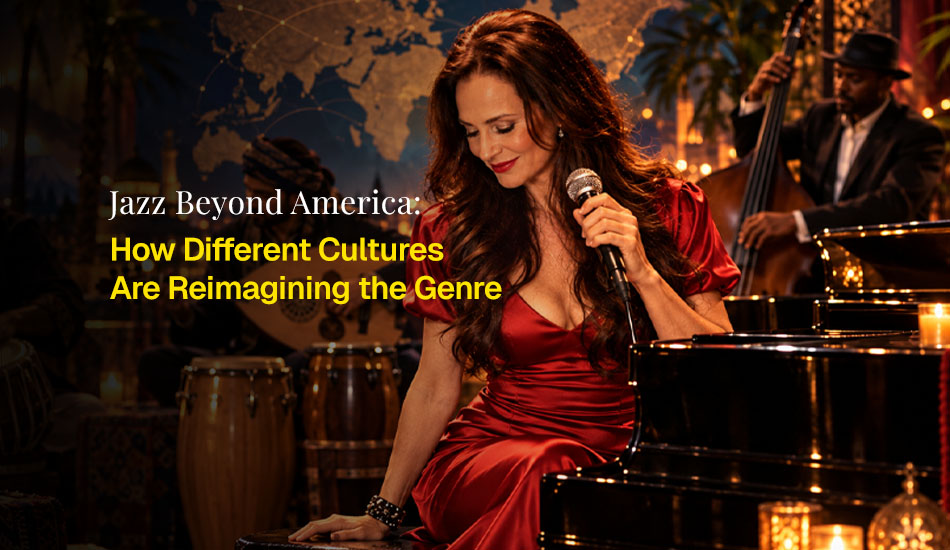
Jazz Beyond America: How Different Cultures Are Reimagining the Genre

Jazz Beyond America: How Different Cultures Are Reimagining the Genre

Jazz may have been born in the United States, but it was never destined to remain within one set of borders.

From its beginnings in African American communities in New Orleans, jazz developed through a remarkable meeting of musical traditions—blues, ragtime, spirituals, African rhythmic influences, European instrumentation, and the lived experiences of Black Americans. Improvisation became one of its defining languages, giving musicians room not merely to perform a composition, but to respond to it.

Perhaps that flexibility helps explain why jazz travels so well.

As the music moved around the world, musicians did not simply reproduce an American sound. They brought jazz into conversation with their own musical histories. Brazilian rhythms, Indian ragas, Japanese aesthetics, African traditions, European classical music, and Middle Eastern modes have all found places within contemporary jazz.

The result is Global Jazz Music: not one uniform international style, but a constantly evolving conversation between cultures.

Jazz crossed borders. Then something more interesting happened—the places it reached began changing jazz in return.

How Jazz Became a Global Genre

Jazz began traveling internationally relatively early in its history.

Recordings, touring musicians, military bands, radio, migration, and international cultural exchange introduced the music to audiences far beyond the United States. European listeners and musicians developed particularly strong relationships with jazz during the 20th century, while scenes also emerged across Latin America, Africa, Asia, and elsewhere.

But the globalization of jazz was never simply a matter of exporting American music.

Musicians heard improvisation and recognized possibilities within it.

Instead of abandoning their own musical traditions, many began bringing those traditions into jazz. Local instruments entered ensembles. Different approaches to rhythm appeared. Folk melodies, classical systems, regional harmonies, and new languages became part of the music.

This is one reason jazz can sound unmistakably like jazz in two countries while sounding completely different in each.

Its identity is strong enough to travel, yet open enough to change.

European Jazz: Tradition Meets Experimentation

Europe has been an important home for jazz for generations.

Cities including Paris, London, Copenhagen, Berlin, Amsterdam, and Oslo developed distinctive jazz communities, supported by clubs, festivals, conservatories, record labels, and dedicated audiences.

Over time, European musicians increasingly developed their own approaches rather than simply modeling themselves after American performers.

Some European jazz draws heavily from classical composition. Elsewhere, musicians incorporate regional folk traditions, electronic music, free improvisation, or spacious, atmospheric arrangements.

Scandinavian jazz, for example, is often associated with an openness of sound—silence can be as meaningful as a note. British jazz, meanwhile, has developed through interaction with Caribbean, African, electronic, hip-hop, and other musical cultures. 

There is no single “European jazz sound,” and that is precisely the point.

Jazz provided the vocabulary. European musicians continued writing their own sentences.

Latin Jazz: Where Rhythm Takes Center Stage

If improvisation is one of jazz’s great freedoms, rhythm is one of Latin jazz’s great engines. To understand the history of Latin jazz, it is important to look at its deep relationship with Latin American music, particularly Afro-Cuban musical traditions.

The relationship between jazz and Latin American music has deep historical roots, particularly through Afro-Cuban musical traditions. Over generations, musicians have explored the meeting points between jazz harmony and improvisation and rhythmic forms from Cuba, Brazil, Puerto Rico, and other parts of Latin America.

Percussion becomes especially important.

Congas, bongos, timbales, claves, and other instruments can transform the rhythmic architecture of an ensemble. Instead of rhythm functioning only underneath a soloist, it often becomes an active voice in the musical conversation.

Brazil contributed another enormously influential dialogue through samba and bossa nova, helping create music that could feel sophisticated and harmonically rich while remaining remarkably intimate.

Latin jazz demonstrates something central to Global Jazz Music: cultural exchange does not have to dilute identity.

At its best, it makes both sides of the conversation more vivid.

African Jazz: Reconnecting Jazz With Its Rhythmic Roots

Any discussion of jazz outside America eventually encounters an important historical circle.

Jazz developed within African American culture, carrying profound African musical inheritances through rhythm, call-and-response, communal music-making, and other traditions transformed through the Black American experience.

When jazz later traveled to Africa, musicians encountered a form that was simultaneously foreign and strangely connected to deeper musical histories.

Across the continent, artists have created distinctive approaches by combining jazz improvisation with local rhythms, instruments, languages, popular styles, and traditional musical forms.

South Africa developed an especially important jazz tradition, shaped by both extraordinary creativity and the country’s political history. Elsewhere, jazz has intersected with highlife, Afrobeat, Ethiopian musical traditions, and numerous regional forms.

It is therefore misleading to speak of “African jazz” as though Africa possessed one musical identity. The continent contains an enormous range of cultures.

What connects many of these expressions is not a particular sound but an ongoing exchange between improvisation and place.

Jazz in Japan: Precision, Creativity, and a Distinct Identity

Japan’s relationship with jazz runs deep.

The country developed a passionate listening culture around the genre, visible not only in concerts and recordings but also in its famous jazz cafés, or jazz kissa. These listening spaces helped create communities where recorded jazz could be experienced with unusual concentration and respect.

Japanese musicians, meanwhile, built a jazz identity of their own.

Technical precision is certainly part of the story, but describing Japanese jazz only in terms of precision misses its creative range. Japanese artists have explored bebop, fusion, free jazz, big-band music, contemporary composition, and experimental forms.

There is also something compelling about Japan’s culture of attentive listening.

In an age when music is frequently consumed in the background, the idea of gathering in a room specifically to listen to a record feels almost radical.

Japan reminds us that a jazz culture is created not only by musicians.

It is also created by listeners.

Indian Jazz: Classical Traditions Meet Improvisation

India presents one of the most fascinating conversations in global jazz because improvisation already occupies a central role in Indian classical music.

Indian classical traditions and jazz are structurally different, but musicians from both worlds understand what it means to work within a framework while creating something spontaneous inside it.

That shared respect for improvisation has opened extraordinary possibilities.

Ragas, rhythmic cycles, tabla, sitar, Indian classical vocal approaches, and other elements have entered conversations with jazz harmony and instrumentation. These collaborations are sometimes placed under broad labels such as Indo-jazz or jazz fusion, although individual projects can differ dramatically.

India also has a longer jazz history than casual listeners may realize. Jazz developed audiences in cities such as Mumbai and Kolkata during the 20th century, and Indian musicians participated in hotel, nightclub, film, and live-performance cultures.

Today’s musicians inherit both histories: India’s own sophisticated improvisational traditions and more than a century of international jazz development.

When these musical worlds meet thoughtfully, neither needs to disappear into the other.

The most interesting music often preserves the tension between them.

Middle Eastern Jazz: New Sounds From Ancient Traditions

Across the Middle East and its diaspora, musicians have also been exploring the space between jazz improvisation and regional musical traditions.

One particularly rich area of interaction involves modal approaches.

Arabic and other Middle Eastern musical traditions include sophisticated melodic systems that differ from conventional Western harmony. Instruments such as the oud and qanun introduce timbres that can completely reshape the familiar sound of a jazz ensemble.

The result can be striking: a double bass and drum kit supporting an oud, a saxophone moving through melodies influenced by regional modes, or traditional rhythmic ideas meeting contemporary improvisation.

These collaborations are most compelling when they go beyond adding an “exotic” instrument to an otherwise conventional arrangement.

Real cultural exchange requires listening.

Jazz, fortunately, has always depended on exactly that.

A New Generation Is Making Jazz Borderless

The internet has accelerated musical exchange in ways previous generations could hardly have imagined.

A young musician no longer needs to live in New York, New Orleans, or another historically important jazz center to encounter adventurous new music. Streaming services, online performances, social platforms, digital collaborations, and international festivals can expose artists to musical ideas from around the world almost instantly.

For listeners, that access has made discovery just as borderless. Jazz playlists from around the world can introduce audiences to Brazilian bossa nova, Japanese jazz, African rhythms, European experimentation, Indian collaborations, and other interpretations of the genre in a single listening session.

A pianist in London can discover an Indian percussionist online. A Japanese ensemble can find listeners in California. An African musician can collaborate with a European producer. A vocalist can build an international audience before ever undertaking an international tour.

For younger musicians especially, genre boundaries can feel increasingly artificial.

Jazz may intersect with neo-soul, hip-hop, electronic music, acid jazz, classical composition, folk traditions, R&B, or sounds that resist a convenient label altogether.

This does not necessarily mean jazz is losing its identity.

It may mean musicians are continuing one of its oldest traditions: absorbing what surrounds them and transforming it through improvisation.

What Global Jazz Music Means for the Future of the Genre

The future of Global Jazz Music will probably not be defined by one dominant sound.

That may be its greatest strength.

Jazz does not need every musician to interpret it in the same way. Its history has always involved evolution—from New Orleans jazz to swing, bebop, cool jazz, hard bop, modal jazz, free jazz, fusion, and countless developments that followed.

Its international evolution is part of that same story.

As musicians bring their languages, instruments, histories, and cultural memories into jazz, they expand what the genre can express.

Technology will make these encounters easier. But technology alone will not make them meaningful.

The most enduring cross-cultural music tends to emerge from curiosity rather than novelty—from musicians taking the time to understand one another’s traditions instead of treating them as decorative ingredients.

When that happens, jazz becomes something more than global.

It becomes a meeting place.

FAQs About Jazz Around the World

Is jazz still an American genre?

Jazz remains fundamentally connected to its African American origins and American history. At the same time, more than a century of international performance, listening, and musical exchange has made it a global art form. Musicians around the world now contribute distinct interpretations while engaging with those historical foundations.

What is European jazz known for?

There is no single European jazz style. Depending on the region and artist, European jazz may incorporate classical composition, folk traditions, electronic experimentation, free improvisation, atmospheric arrangements, and influences from immigrant and diaspora cultures.

How is Latin jazz different from American jazz?

Latin jazz generally brings jazz improvisation and harmony into conversation with rhythmic traditions associated with Latin America and the Caribbean, particularly Afro-Cuban music. Percussion and distinctive rhythmic patterns often play central roles. However, Latin jazz itself contains many different approaches.

Which countries have the biggest jazz scenes today?

The United States remains central to jazz, while strong scenes and audiences can also be found across countries such as the United Kingdom, France, Germany, Italy, Japan, Canada, the Netherlands, Norway, South Africa, Brazil, and others. The scale and character of these communities vary, and vibrant scenes also exist well beyond the countries most commonly associated with the genre.

What makes Japanese jazz distinct?

Japanese jazz spans many styles, so it cannot be reduced to one sound. Its history includes enthusiastic record culture, dedicated jazz listening cafés, technically accomplished musicianship, and artists working across traditional, fusion, avant-garde, and contemporary forms.

How has jazz changed outside the United States?

Musicians have combined jazz with local rhythms, instruments, languages, compositional approaches, and musical traditions. Rather than simply reproducing American jazz, many international artists have developed distinct forms that reflect their own cultural experiences.

Conclusion: Jazz Was Born in America, but Its Conversation Became Global

Jazz’s journey around the world is not a story of one musical culture replacing another.

It is a story of conversation.

America gave jazz its beginnings, shaped profoundly by African American history and creativity. But as the music traveled, musicians elsewhere did what jazz musicians have always done: they listened, responded, improvised, and added something of themselves.

Europe brought its own compositional and experimental perspectives. Latin America intensified rhythmic conversations. African musicians connected jazz with diverse musical traditions across the continent. Japan developed an extraordinary culture of performance and attentive listening. India found common ground through improvisation. Middle Eastern artists brought different modal languages and instrumental colors into the dialogue.

And the conversation is nowhere near finished.

The most exciting possibility for Global Jazz Music is not that every culture will eventually sound connected.

It is that they won’t.

The beauty lies in the difference in hearing how the same spirit of improvisation changes when it encounters another language, another rhythm, another history, another way of understanding sound.

Jazz crossed the world without becoming one thing.

Perhaps that is exactly why it still has so much left to say. 
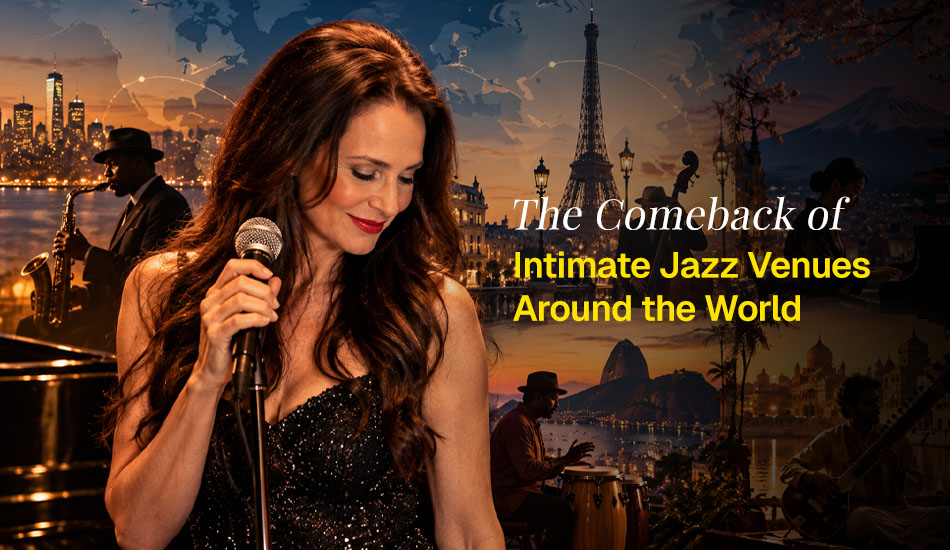
The Comeback of Intimate Jazz Venues Around the World

The Comeback of Intimate Jazz Venues Around the World

There is a particular moment that happens in a small jazz room just before the music begins.

Conversations soften. Glasses settle onto tables. The lights seem a little warmer. A pianist touches the first chord, the bass enters almost underneath it, and suddenly the distance between musician and listener disappears.

That closeness has always been part of jazz’s magic.

For years, the music industry seemed to be moving in the opposite direction: bigger stages, enormous festivals, elaborate productions, and increasingly digital listening habits. Yet alongside that scale, there is renewed appreciation for something smaller and more personal — intimate jazz venues where audiences can hear the breath behind a lyric, the movement of a drummer’s brushes, or the subtle conversation between musicians.

From New York and Los Angeles to Paris, London, Tokyo, and beyond, small jazz rooms continue to hold an important place in the culture of live music. Their appeal isn’t nostalgia alone. In an increasingly digital world, they offer something technology cannot fully reproduce: presence.

What Makes an Intimate Jazz Venue Special?

An intimate jazz venue isn’t defined only by its capacity.

It is defined by proximity.

In a large concert hall, there is usually a clear separation between performer and audience. In a small jazz club, those boundaries soften. Listeners may be only a few feet from the musicians. Every expression, breath, cue, and improvisational decision becomes part of the experience.

That closeness changes the performance, too.

Jazz musicians listen constantly — not only to each other, but also to the room. A particularly attentive audience can alter the energy of a set. A vocalist may linger over a phrase. A pianist may leave more silence between notes. A solo may wander somewhere unexpected.

The audience isn’t directing the performance, but its presence becomes part of the evening.

That is what makes a small jazz room feel less like watching music and more like being inside it.

Why Are Intimate Jazz Venues Making a Comeback?

Modern life gives us almost unlimited access to recorded music. We can hear a song within seconds, watch concerts from another continent, or discover an entire discography without leaving home.

Convenience, however, is not the same as connection.

The more life moves onto screens, the more meaningful physical experiences can become. A live jazz performance requires something increasingly rare: attention. You cannot swipe to the next moment. You are simply there while the music unfolds.

Jazz is particularly suited to this environment because improvisation makes every performance temporary.

The version of a song heard tonight may never exist in precisely the same way again.

That sense of impermanence gives intimate jazz venues their emotional value. People aren’t only paying to hear songs they recognize. They are entering a room where something unrepeatable might happen.

How Jazz Venues Are Evolving for Modern Audiences

The classic image of a jazz club — low ceilings, dim lighting, tiny tables and a glowing stage — remains wonderfully alive. But the contemporary jazz venue is also evolving.

Some clubs are improving acoustics and sound systems while deliberately preserving the warmth of the room. Others combine jazz with thoughtful dining programs, cocktail menus, vinyl culture, artist conversations, or late-night sets.

Digital tools have also changed how audiences discover these spaces.

A single live clip shared online can introduce a small venue to people thousands of miles away. Artists can announce upcoming live dates directly to their audiences, while venues can use social media to show the character of the room rather than simply advertise a schedule.

The experience remains analog. The discovery of that experience increasingly begins digitally.

Cities Keeping Intimate Jazz Culture Alive Around the World

Jazz has never belonged to just one city. Its roots are distinctly American, but its language has traveled remarkably well.

New York City

Few places are as closely associated with small-room jazz as New York.

The intimate clubs of Greenwich Village have helped create a mythology around jazz that continues to attract listeners from around the world. In these rooms, proximity is part of the tradition: musicians and audiences sharing a compact space while the city moves outside.

New York remains an essential destination for anyone exploring the world’s best live jazz venues, particularly for listeners who want to experience jazz in rooms where history and contemporary performance coexist.

Los Angeles

Los Angeles has its own jazz personality — expansive, sophisticated and connected to a long history of recording, film, songwriting and performance.

The city’s scene ranges from established clubs to smaller listening rooms and performance spaces. For audiences interested in contemporary jazz singers in Los Angeles, intimate venues provide an opportunity to experience vocal storytelling without the emotional distance of a large stage.

Paris

Jazz found an enduring second home in Paris.

Its clubs often combine history with an unmistakably European atmosphere: cellars, close seating, late-night performances and audiences who come specifically to listen.

The relationship between Paris and jazz also reflects the genre’s extraordinary ability to cross cultural boundaries without losing its identity.

London

London’s jazz culture brings together tradition, experimentation and a remarkably diverse generation of musicians.

Alongside major concert spaces, smaller venues continue to be essential places for discovering emerging performers and hearing established musicians in more personal settings.

Tokyo

Tokyo has cultivated a distinctive listening culture around jazz.

Its relationship with the genre extends beyond concerts into record collecting, jazz cafés and spaces where attentive listening itself becomes part of the ritual. That respect for detail makes the city particularly interesting for people who value the quieter side of jazz culture.

New Orleans

Any conversation about jazz venues ultimately returns to New Orleans.

Here, jazz isn’t merely something scheduled for the evening. It is woven into the cultural identity of the city. Small clubs and neighborhood performance spaces preserve the immediacy that has always made the music feel alive.

Why Small Jazz Venues Matter to Musicians

For musicians, a small room can be both liberating and demanding.

There is nowhere to hide.

A vocalist cannot rely on spectacle to carry a lyric. A musician’s smallest choices become audible. Subtlety matters. Silence matters. Communication between players matters.

That vulnerability can produce extraordinary performances.

For a singer, especially, intimate venues allow storytelling to become almost conversational. An album such as Soliloquy, built around reflection, language, emotional nuance and the intimacy of the human voice, naturally points toward the qualities that make small-room listening so compelling.

The audience can hear not only the song, but the intention behind it.

Small venues are also vital to the broader jazz ecosystem. They provide stages where musicians can experiment, develop material, form collaborations and establish relationships with listeners over time.

Why Audiences Are Returning to Small Jazz Clubs

Part of the attraction is simple: people want experiences that feel real.

Large concerts can be exhilarating, but small jazz clubs offer something different. There is less spectacle between the listener and the music.

You notice details.

The bassist smiles when the pianist changes direction. The vocalist takes an extra second before entering a phrase. The drummer responded quietly to a solo. The room becomes completely still during a ballad.

These details are difficult to reproduce through headphones.

For listeners accustomed to highly edited digital content, that imperfection can feel refreshing. Jazz reminds us that something does not have to be flawless to be beautiful. Sometimes its humanity is precisely what makes it memorable.

The Role of Food, Cocktails and Atmosphere

A great jazz evening involves more than sound.

Lighting, seating, service, architecture, food and drinks can all influence how the room feels. Done well, these elements create an atmosphere without competing with the performance.

A cocktail arriving quietly before the first set, dinner shared over conversation, or a candlelit table near the piano can transform a concert into an evening with its own rhythm.

But the atmosphere should never overwhelm the music.

The finest clubs understand this balance. Hospitality creates comfort; the musicians create the reason everyone came.

That distinction is what separates a genuine listening room from a bar that happens to have jazz playing in the background.

How to Find Great Intimate Jazz Venues When Traveling

Jazz can be one of the most rewarding ways to experience a city.

Instead of limiting your search to famous venues, look at local jazz publications, musicians’ websites, festival programs, cultural calendars and venue social pages. Search the upcoming live dates of artists you already enjoy and see where they perform.

It is also worth looking beyond the obvious tourist districts. Some memorable jazz experiences happen in neighborhood clubs, hotel lounges, small theaters, arts spaces and restaurants with dedicated listening programs.

When evaluating a venue, consider the room itself. Does it present jazz as the main event? Is the seating close to the stage? Are audiences encouraged to listen during performances? Does the calendar feature working jazz musicians consistently?

For particularly popular rooms, booking ahead is wise. Smaller capacity is part of the appeal, but it also means seats can disappear quickly.

What Does the Future Look Like for Intimate Jazz Venues?

The future of small jazz rooms will depend on more than musical demand.

Operating a venue can be difficult. Rent, staffing, artist fees, food and beverage costs, licensing, and changing nightlife habits all affect sustainability. A packed room does not automatically mean an easy business.

Yet these challenges also underline why audience support matters.

Buying a ticket, ordering dinner, purchasing an artist’s record, attending a second set, or recommending a club to friends helps maintain an ecosystem that streaming cannot replace.

Technology will continue changing how jazz is distributed and discovered. But it may actually make physical spaces more meaningful.

When almost every recording is available instantly, scarcity moves somewhere else.

The scarce thing becomes the moment.

And intimate jazz venues specialize in moments.

FAQs About Intimate Jazz Venues

What is an intimate jazz venue?

An intimate jazz venue is generally a smaller performance space where the audience sits relatively close to the musicians. The defining characteristic is not a specific seating capacity but the sense of proximity, attentive listening and connection between performer and audience.

Why are small jazz clubs becoming popular again?

They offer an experience that contrasts with digital listening and large-scale entertainment. Audiences can experience live improvisation, emotional nuance and a stronger sense of connection with musicians.

Which cities are famous for intimate jazz clubs?

New York, New Orleans, Los Angeles, Paris, London and Tokyo are among the cities known for strong jazz cultures and small live-music spaces. Many other cities around the world also support vibrant local jazz scenes.

What should you expect at a small jazz venue?

Expect close seating, relatively low lighting, attentive audiences and a stronger focus on the music. Some venues offer full dining, while others operate primarily as listening rooms or bars.

Do you need to book jazz clubs in advance?

It depends on the venue and artist, but advance reservations are often recommended. Small clubs have limited seating, and performances by popular musicians can sell out quickly.

What is the difference between a jazz club and a jazz bar?

A jazz club typically treats live performance as its central attraction, with audiences primarily there to hear the musicians. A jazz bar may place equal or greater emphasis on drinks, dining and socializing, with music forming part of the overall atmosphere.

Final Thoughts: The Enduring Appeal of Live Jazz

The return of intimate jazz venues is not really about returning to the past.

It is about rediscovering something we still need.

Jazz asks for presence. A small room intensifies that request. There is no enormous screen telling us where to look and no production spectacle competing for our attention. There is a voice, an instrument, a roomful of strangers — and the possibility that, for a few minutes, everyone will listen together.

From the historic intimate clubs of Greenwich Village to contemporary rooms showcasing jazz singers in Los Angeles, the most compelling venues understand that intimacy isn’t about size alone. It is about removing the distance between music and the listener.

Perhaps that is why people continue searching for the world’s best live jazz venues even when virtually every recording they could want already exists in their pocket.

We can stream the song whenever we like.

But we can only be in the room once.

Soliloquy: Where Every Nuance Tells a Story.

Marc Medwin’s review of Soliloquy focuses on Sylvia Brooks’ remarkable ability to find meaning in the smallest vocal and lyrical details. He highlights the subtlety of her interpretation—how a slight change in dynamics, timbre, or emphasis can reveal an entire character or emotional truth. Her classical theater training is central to this approach: Brooks moves between characters and emotions without overstating them, allowing songs such as “Soul Eyes,” “Lizzie’s Dance,” “Temptation,” and “Talks a Good Game” to unfold as intimate dramatic moments. Particularly moving is “Lizzie’s Dance,” where Brooks’ voice captures the freedom and individuality of a young dancer with Down syndrome, transforming the song into a tribute to artistic individuality.

The review gives equal attention to the musicianship surrounding Brooks. Christian Jacob’s sensitive playing and arrangements support her storytelling throughout, while the choral writing on “Fragile,” Farzin Farhadi’s saxophone on “Lizzie’s Dance,” Kevin Axt’s bass on “Talks a Good Game,” Kevin Winard’s delicate cymbal work, and Grant Geissman’s guitar on “A Letter to Sophie” deepen the album’s emotional character. Medwin ultimately portrays Soliloquy as an ambitious yet finely controlled work in which voice, arrangement, and ensemble playing serve a singular artistic vision—moving naturally from subtle musical detail toward deeper emotional expression.

Read More

Soliloquy: Giving Voice to What Lives Underneath

The review presents Soliloquy as Sylvia Brooks’ most revealing artistic statement; an album shaped by her instinct to notice what lies beneath ordinary moments. Experiences that stop her emotionally, sometimes before she understands why, become the starting point for songs exploring love, deception, desire, courage, loss, and fragility. Rather than explaining those emotions directly, Brooks builds intimate scenes and characters that allow listeners to discover the feeling for themselves. Songs such as “A Letter to Sophie” and “Lizzie’s Dance” show this approach vividly, turning encounters with art and everyday life into stories about heartbreak, perception, dignity, and courage.

The review also traces how Soliloquy brings together the different strands of Brooks’ artistic life: the jazz she inherited from her musical family, her classical acting training, her development as a songwriter, and her long collaboration with pianist and arranger Christian Jacob. Whether interpreting “Soul Eyes,” inhabiting the darker character of “Talks a Good Game,” finding a personal connection to “Fragile,” or exploring the raw pull of “Temptation,” Brooks places meaning before vocal display. The title Soliloquy ultimately captures the album’s essence: innermost thoughts given voice, with music finding its way toward the emotions people often feel but rarely say aloud

Read More

Goldmine Magazine Interview Sylvia Brooks on Why ‘Soliloquy’ Is Her Most “Honest and Stripped-Down” Work Yet

Goldmine describes Sylvia Brooks’ Soliloquy as her most profound, jazz-centered, and emotionally honest work to date—an album rooted in the private truths of the human experience. Brooks explains that the record grew not from a predetermined concept, but from personal encounters and observations that moved her deeply, eventually revealing a common thread: how people navigate love, vulnerability, temptation, judgment, heartbreak, and the choices that define their humanity. Working closely with composer and arranger Christian Jacob, Brooks sought a stripped-down sound that would allow each story to speak without unnecessary embellishment. Songs including “Soul Eyes,” “Talks A Good Game,” “A Letter to Sophie,” “Fragile,” “Temptation,” and the deeply personal “Lizzie’s Dance” each examine a different dimension of human nature. Goldmine praises Brooks’ ability to make these stories emotionally believable, ultimately calling Soliloquy her “magnum opus” – a body of work that places an honest microscope on the human experience and finds connection in the truths we often leave unspoken.

Read More