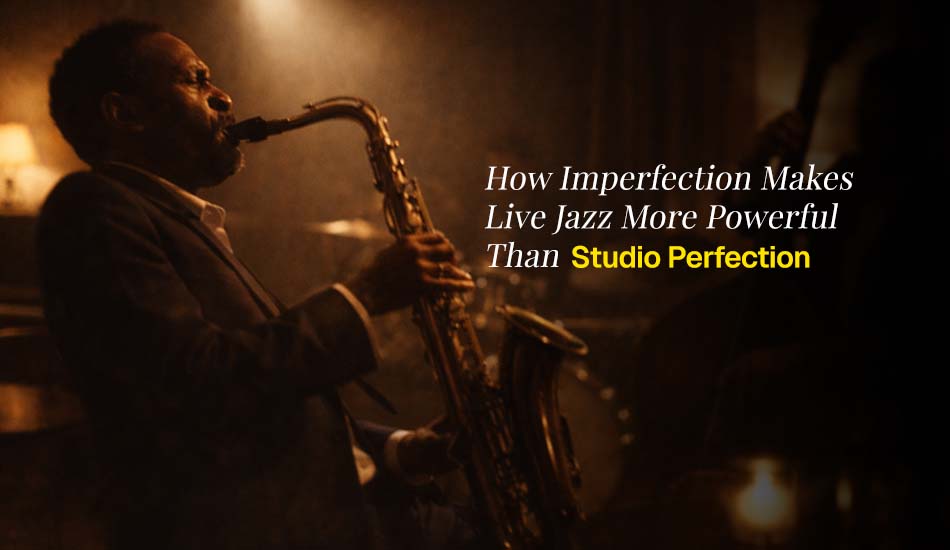
In an era where technology can make music so tidy and orderly that even the smallest details are edited, polished, and perfected, the unexpected is happening; the imperfections audiences once shunned are slowly becoming acceptable in music once again. Nowhere is such a tendency more obvious than in jazz.
There are often unexpected pauses, really long solos, or even mistakes and bloopers in live jazz. And yet, all this disorder is what makes it so gripping.
Comparing live jazz vs studio perfection, it is clear that technical flawlessness is far from being the same as true presence.
Many listeners who explore the best jazz songs often notice this emotional difference immediately.
Jazz reminds us that music isn’t just precision work; it is living emotion and human connection.
Jazz Was Never Meant to Be Perfect
From its earliest days, jazz was based on spontaneity and improvisation.
It was never intended to be made into some sort of perfected thing, but rather experienced in the moment.
Early jazz groups performed in clubs, streets, and informal gatherings. The idea was not to play flawlessly but to express oneself.
This is the platform from which to understand live jazz vs studio perfection.
Jazz was never intended to be a closed form. Rather, it should grow and change, taking as its cue the circumstances in which it was played.
Imperfection Provides Emotional Authenticity
A particularly striking feature of live jazz is its emotional frankness.
When a note goes wrong, or one phrase takes an unexpected twist, the listener is reminded that this music is being composed in real time. This is why many female jazz vocalists embrace imperfection as part of their expression.
Such moments have a unique feeling of authenticity which smooth records often lack. Not only can the listener hear the music, but he is also entering into its unfolding.
This immediacy of feeling is what makes live jazz so absorbing.
The Power of Real-Time Improvisation
Jazz, as a spirit and as a way of creation, is based entirely on improvisation. In a live context, musicians react to one another, the audience, and the moment itself.
A solo may go on longer than planned or change direction in mid-melody. Out of control, these decisions are: they simply come.
Comparing live jazz vs studio perfection, improvisation is a key defining quality. Each performance becomes unique. Each one can never be copied or repeated.
Many iconic moments within the best jazz songs have come directly from such improvisational brilliance.
Studio Perfection and Human Expression
Studio recordings offer precision, clarity, and consistency.
Each take allows musicians to perfect their playing: mistakes are corrected, resulting in a polished final product.
But this also has its drawbacks in that the raw energy, which makes music feel alive, is sometimes left out. On the other hand, live jazz embodies human expression in its purest form.
Artists like Sylvia Brooks, a jazz singer, demonstrate how emotional storytelling in jazz goes far beyond technical perfection.
In contrast, the above contrast has important consequences: while perfection may impress, imperfection connects.
The Magic of Mistakes
In jazz, mistakes are not always wrong. By making a slip of the fingers, new melodic ideas are generated. Timing changes can produce varied rhythmic approaches.
Often, what remains most in people’s memory are these instances when things went wrong or not as planned at all.
Great moments in the best jazz songs have often developed during live performances through such accidental discoveries.
This gift for turning errors into creativity is something essentially different about jazz, and why it attracts so many people.
Contact with the Audience Live jazz is an experience shared
The audience is not simply listening; they are part of the performance.
Their reaction, energy, and presence all influence the musicians in real time.
A responsive audience can spur risk-taking in one sense, creating an exhilarating performance that crackles with life and vitality.
This is another major distinction when comparing live jazz vs studio perfection; the shared energy cannot be recreated artificially.
Imperfections Are A Mirror for Real Life
Therefore, imperfection often mirrors the imperfection seen in life. The background to a jazz song is both magical and flawed, much like life, and from day to day, it is always changing, unpredictable, or emotional.
Jazz comes closer than any other form of music to reflecting this reality.
The pauses, hesitations, and deviations from the expected flow in jazz live reveal the way life unfolds itself. That human feeling is the kernel quality that makes jazz so real.
This is why artists such as Sylvia Brooks, a jazz singer, continue to connect deeply with audiences through authentic expression.
Why Modern Audiences Seek Out Imperfections Once Again
In today’s world, audiences are surrounded by highly processed, edited content.
From social media to pop music production, everything is designed to come out smooth and clean.
These days, such perfection feels thwarting. The result is a trend towards authenticity among modern audiences.
Listeners gravitate to music that feels real, acknowledging its imperfections rather than trying to hide them, something clearly present in performances by female jazz vocalists.
Imperfection as a Creative Advantage
Imperfection can, in fact, be turned into a special weapon instead of representing any disadvantage.
In jazz, it tends to bring a breath of vitality and an openness to new ideas. Musicians are encouraged to experiment, take risks, and discover things available in no other way.
This artistic freedom is particularly apparent among modern female jazz vocalists and performers who are moulding the genre through their own expression.
Just like how an artist such as Sylvia Brooks Jazz Singer can use emotional storytelling and deft performance, to make a deeper connection with listeners.
How Other Genres Are Learning From Jazz
Many modern genres are now drawing some lessons from the imperfection of jazz.
Lo-fi music, for example, makes use of background noise and slight imperfections on purpose in order to create a more relaxed sound.
This influence can also be traced back to the improvisational essence found in the best jazz songs, which continue to inspire new-age music production.
Conclusion
This contrast between live jazz and performance, edited sound or recordings, is not a matter of choosing one way or the other. Both kinds have a place in music history.
However, when we compare live jazz vs studio perfection, it becomes clear that live jazz offers something deeply human and irreplaceable.
So studio recordings can give us listeners clarity. We can play them again and again, and by doing so, come to appreciate their structure.
Live jazz, however, is something else entirely. It offers an entirely different experience, something unmediated for those who are there, at that moment, and alive with immediate feeling.
In embracing imperfection, jazz reminds us that beauty is not just about precision; it is about expression, connection, and authenticity.
FAQs
Why does live jazz sound different every time?
Live jazz thrives on improvisation. So musicians adapt performances according to the prevailing conditions of the age, making every edition special. This is one of the defining aspects of live jazz vs studio perfection
Are mistakes serious in jazz?
Yes. Many defining moments in the best jazz songs come from unexpected improvisation.
Why do people prefer live music to studio recordings?
Because it feels more real and emotionally engaging, especially when performed by female jazz vocalists and expressive artists.
What is unique about jazz improvisation?
Its spontaneity and personal expression are something artists like Sylvia Brooks, a jazz singer, represent beautifully.